Most people learn about this the worst possible way. A renewal comes back denied, or an application stalls with no explanation, and there is already a trip paid for. The tax debt they had been quietly living with turns out to have crossed a line they did not know existed. It is one of the few IRS consequences that reaches into a part of life having nothing to do with money, and it is also one of the most reversible if you move on it.
Can the IRS Revoke a U.S. Passport
Not directly. The IRS does not issue or cancel passports. What it can do under Internal Revenue Code section 7345 is certify to the State Department that you have a seriously delinquent tax debt. Once that certification lands, the State Department is the one that acts. It will generally deny a new passport application, deny a renewal, and it has the authority to revoke or limit a passport you already hold.
In practice, denial is far more common than revocation. The State Department usually holds an application rather than pulling a passport out of someone’s hand. But revocation is a real power written into the statute, and it becomes more likely when someone travels internationally on a certified debt and ignores the notices about it.
What Seriously Delinquent Tax Debt Means
Seriously delinquent tax debt is a defined term, not a description. It means a legally enforceable federal tax liability above a dollar threshold set in the statute, where the IRS has either filed a Notice of Federal Tax Lien with appeal rights exhausted or issued a levy.
The Threshold and Why the Number Moves
The threshold is adjusted every year for inflation, so the figure that applied when a friend went through this is not the figure that applies to you. IRS.gov publishes the current amount, and it is the first thing to check rather than the first thing to assume. The threshold counts total assessed liability including penalties and interest, not just the original tax, which is how balances that started well under the line end up over it.
Which Debts Count and Which Do Not
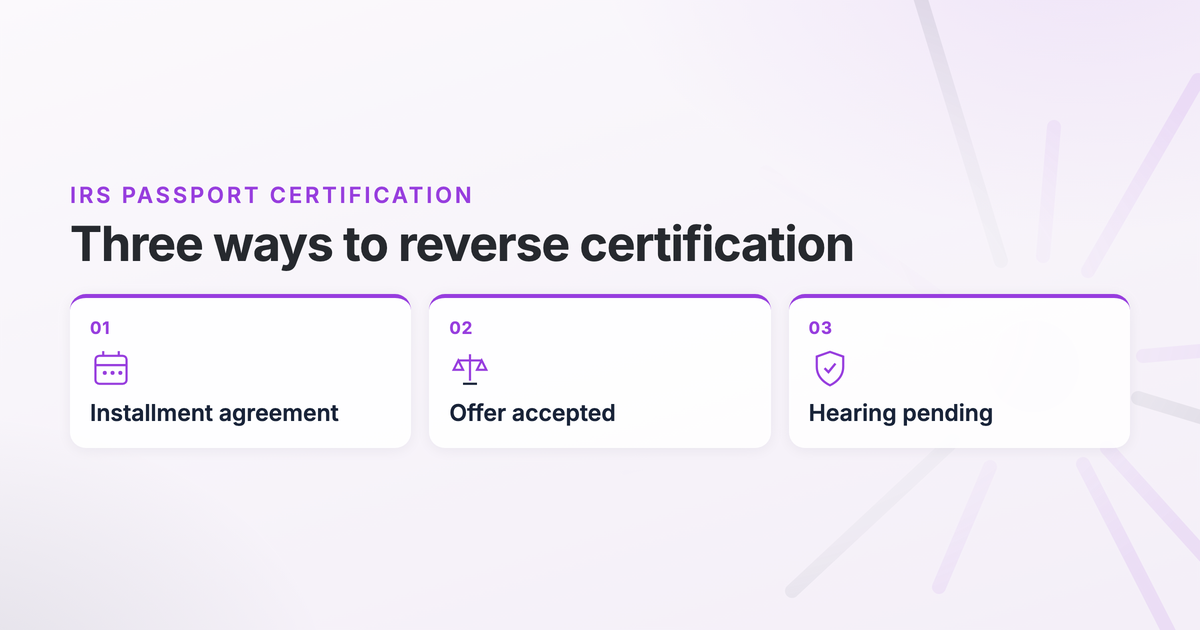
Only federal tax debts count. State income tax, local property tax, and child support sit outside this statute entirely. Several federal balances are also excluded while they are in the right posture, including debts being paid under an accepted installment agreement, debts under an accepted offer in compromise, and debts with a pending Collection Due Process hearing. Accounts in an identity theft hold and certain disaster relief situations are excluded as well.
That exclusion list is the whole strategy. The point is not to argue the debt away. The point is to move it into one of the categories the statute already treats as resolved.
How Much Can I Owe the IRS and Still Get a Passport
You can owe a great deal and keep your passport, as long as the debt is not certified. That is the part people get backwards. Certification is not triggered by the size of the balance alone. It requires the balance to be over the threshold and the account to sit in an enforcement posture, meaning a lien has been filed with appeal rights exhausted or a levy has been issued.
A balance under the threshold does not get certified. A balance over the threshold that is being paid under a signed installment agreement does not get certified either. If your debt is in the range where this becomes a question, our page on what to do when you owe the IRS more than ten thousand dollars covers how the tiers change what the IRS does with an account.
How to Know If the IRS Revoked a Passport
You will get a notice, and the notice is called CP508C. The IRS is required to send it at the same time it sends the certification to the State Department, which means it goes to your last known address rather than to wherever you actually are. If you have moved and never filed a change of address, this is exactly the letter that goes missing.
There are three ways to check without waiting for mail. Order your IRS account transcript and look for the certification entry. Call the IRS number listed for passport certification questions. Or, if an application is already in process, ask the State Department about the status of that application. When certification is reversed, the IRS issues a CP508R, and that is the document you want in hand before you book anything.
Certification usually follows the same escalation everyone else’s account follows, which means you probably saw earlier warnings. Our breakdown of the CP501 letter and what it starts shows the front end of that sequence, and the guide to an IRS Letter 1058 covers the enforcement notice that often sits right before a certification.
Are U.S. Citizens Having Their Passports Revoked
Some are, though the volume is smaller than the internet suggests. The far more common outcome is a denied application or a stalled renewal. The people most affected are not the ones with the largest balances. They are the ones with balances above the threshold who stopped opening IRS mail, because certification requires an enforcement posture that only develops after notices go unanswered.
We see it most in three groups. Business owners with payroll or self employment balances that grew across several years. People who moved and never updated their address with the IRS. And taxpayers who went years without filing and had returns prepared for them by the IRS, which produces a balance far larger than the real one.
How Certification Actually Happens
Certification is the end of a chain, not a standalone event. A return is filed or a substitute return is prepared. The balance is assessed. Notices go out. The account escalates to a lien filing or a levy. Once the balance clears the threshold and one of those enforcement events is on the record, the account becomes eligible for certification, and the IRS sends it to the State Department with the CP508C going to you at the same time.
Every link in that chain is a place where the outcome changes. That is the useful thing to understand about it. There is no single day when this becomes irreversible.
How to Reverse Certification and Get Your Passport Back
Reversal is not discretionary. When you move the debt into an excluded category, the IRS is required to reverse the certification and notify the State Department. The question is which category you can realistically reach and how fast.
Pay in Full or Enter an Installment Agreement
Full payment reverses certification. So does entering an installment agreement the IRS accepts, and that path is open to far more people than assume it is. This is the fastest route for most taxpayers we work with, because an agreement can be established while a dispute over the balance continues.
Offer in Compromise or Currently Not Collectible
An accepted offer in compromise reverses certification, though acceptance takes months and the application itself does not stop the clock. Hardship status is the other route. Our page on currently not collectible status in Illinois and Nevada explains who qualifies, and our overview of settling tax debt for less than you owe covers what the IRS actually looks at in an offer.
Request a Hearing
If a Collection Due Process request is pending, the debt is excluded while it sits there. Deadlines govern this and they are short, which is why the hearing route works best for people who catch the notices early rather than after a passport is already denied.
Passport Risk in Illinois and Nevada
Certification is federal, so a Peoria taxpayer and a Las Vegas taxpayer face identical rules. What differs is who tends to get caught by it. In Las Vegas we see it most with people in hospitality and gaming who travel, and with business owners carrying payroll tax balances. In central Illinois it is more often self employed trades and professionals with several years of unfiled or underpaid returns behind them.
One honest note about who should help you. We are an enrolled agent firm, not a law firm, and nobody here is an attorney. Enrolled agents are federally licensed and hold unlimited rights to represent taxpayers before the IRS under Circular 230, which covers everything this problem requires, from filing the agreement to arguing the account with collections. If your situation involves a criminal referral, or you need someone to take a matter into Tax Court, that is genuinely attorney work, and we will send you to an attorney rather than take the case.
When a Passport Problem Needs Help This Week
If there is travel on the calendar, the timeline matters more than the strategy. A reversal notice to the State Department takes time, and the State Department then needs time of its own. Someone with a trip in three weeks needs a different plan from someone with a renewal due next spring, and both are workable if you start now.
Bring us the CP508C if you have it, or just tell us what the balance is and how long it has been there. We pull the transcripts, confirm whether certification has actually happened, and lay out which exclusion you can reach fastest. Start with a free consultation and we will read the account with you.
FAQ
Can the IRS revoke a U.S. passport?
Not on its own. The IRS certifies seriously delinquent tax debt to the State Department under Internal Revenue Code section 7345, and the State Department is what denies, limits, or revokes the passport. Denial of a new application or renewal is the most common outcome.
How to know if an IRS revoked a passport?
The IRS sends notice CP508C when it certifies a debt, mailed to your last known address. You can also confirm it by ordering an IRS account transcript or by calling the IRS number listed for passport certification questions. Reversal is confirmed by notice CP508R.
Are U.S. citizens having their passports revoked?
Some are, though denied applications and stalled renewals are far more common than outright revocation. The taxpayers affected are typically ones whose balance passed the statutory threshold and whose accounts reached a lien or levy posture after notices went unanswered.
How much can I owe the IRS and still get a passport?
Owing alone does not cost you a passport. Certification requires a balance above the inflation adjusted threshold in the statute plus an enforcement event such as a filed lien with appeal rights exhausted or an issued levy. A balance being paid under an accepted installment agreement is excluded regardless of size.

Written by
William Sharpe, E.A., C.T.R.S.
Founder & Certified Tax Resolution Specialist
William has been in the tax business since he was 8 years old, starting in the mail room of the family enterprise. He began filing tax returns in 1999 and spent decades shadowing his grandfather, founder Bill Sharpe. In 2005 he teamed with Bill & Deborah Sharpe to open Total Income Tax — today the busiest tax office in Peoria — and in 2016 he founded Total IRS Relief to help taxpayers resolve their IRS and Illinois tax struggles.
Meet the teamNeed help with your case?
Talk to an Enrolled Agent. Free 15-minute consultation, no obligation.