This is the letter people bring us in person rather than emailing. It arrives certified, it says the IRS intends to levy, and the deadline printed on it is statutory rather than administrative.
Thirty days. What happens inside them is largely up to you. What happens after them is largely not.
What a CP90 Notice Means
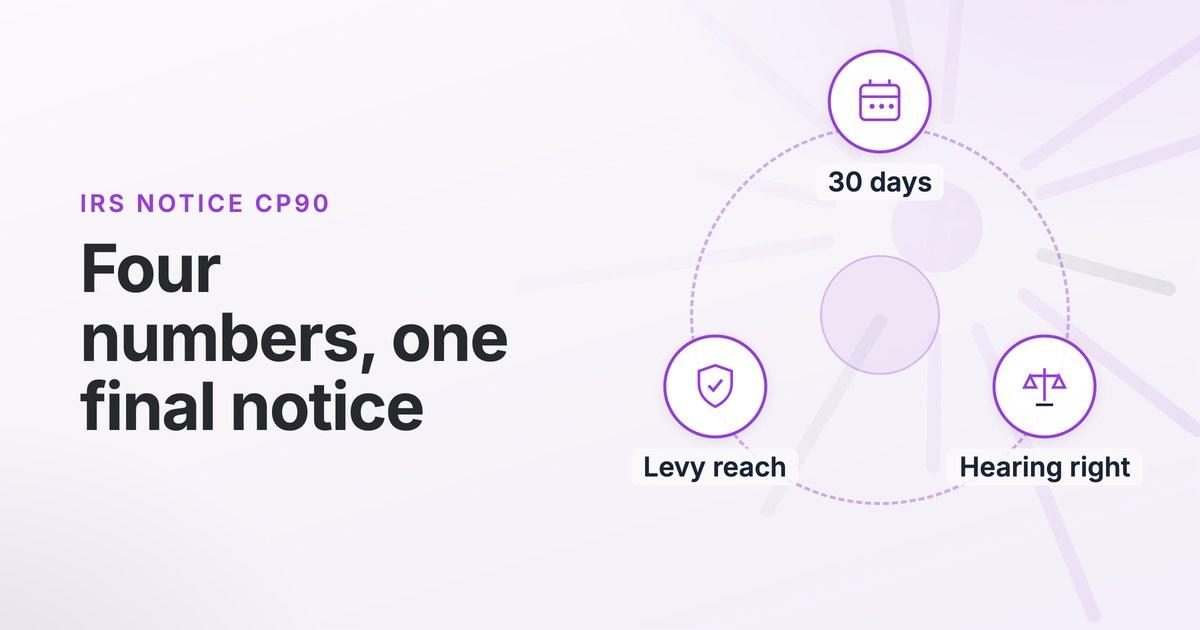
A CP90 is the IRS telling you it intends to levy certain assets for unpaid taxes and notifying you of your right to a Collection Due Process hearing. It is the last notice before enforced collection, and the 30 day period it opens is the window in which you can still choose the outcome rather than react to one.
CP90, CP297, LT11 and Letter 1058 Are the Same Notice
Why the IRS Uses Four Numbers
There is one statutory notice here, the Final Notice of Intent to Levy and Notice of Your Right to a Hearing, and the IRS issues it under different numbers depending on which function sent it and what kind of taxpayer you are. Publication 1660 lists it once, as a single item on the short list of notices that carry Collection Due Process rights.
The IRS’s own pages line up behind that. It publishes CP90 and CP297 separately with materially the same content, and it titles a third page LT11 notice or letter 1058, treating those two numbers as one document outright.
Which One You Have
Look at the upper right corner of page one. If the number is CP90, CP297, LT11 or Letter 1058, the answer to what you are holding is the same and so is the deadline. What differs is nothing you need to act on differently.
Our IRS notice guide records the same thing from the practitioner side. CP90 and CP297 are the Final Notice of Intent to Levy on the same 30 day CDP window as LT11 and Letter 1058.
One number that is not this notice is CP504. That letter is a notice of intent to levy in the automated series and it authorizes the IRS to take a state tax refund, but it is not the final notice and it does not carry the hearing right. Our post on what a CP504 notice means covers the earlier stage.
The 30 Day Clock
What the IRS Can Take When It Expires
Once the 30 days pass without a resolution or a timely hearing request, the IRS can attach a levy to wages and other income, bank accounts, business assets, personal assets including a car or a home, state tax refunds, Alaska Permanent Fund Dividends and Social Security benefits. Its own LT11 and Letter 1058 page sets that list out. It may also file a Notice of Federal Tax Lien, which is public and which surfaces later against a sale, a refinance or a credit application.
There are four situations in which the IRS does not have to give you the 30 days first. When collection of the tax is in jeopardy, when the levy is against a state tax refund, when it is a federal contractor levy, and when a Disqualified Employment Tax Levy applies. In those cases the notice and the appeal rights follow the levy instead of preceding it.
An unpaid balance at this stage also reaches a passport. The IRS certifies seriously delinquent tax debt to the State Department once it exceeds a threshold that is adjusted yearly for inflation, which for 2026 is $66,000, and the State Department will generally not issue a passport after that.
What It Cannot Take
Some property is exempt by law. Publication 594 names unemployment benefits, certain annuity and pension benefits, certain service connected disability payments, worker’s compensation, certain public assistance payments, a minimum weekly exempt income amount, assistance under the Job Training Partnership Act, and income for court ordered child support. Necessary schoolbooks and clothing and undelivered mail are also outside a levy.
That list is narrower than people hope and wider than people fear, and none of it is automatic in the sense of protecting a bank account that has already been reached.
Your Appeal Right, in One Paragraph
The CP90 exists because the law requires the IRS to offer you a hearing before it levies. Requesting a Collection Due Process hearing within the 30 day period from the date of the notice preserves the right to have Appeals look at the collection action and to take the determination to the Tax Court. Miss the 30 days and a later request becomes an equivalent hearing, which is a lesser thing. Appeals still looks, but the Tax Court route is gone. The mechanics of the request are their own subject and this post is not it. The date on the letter is the part that cannot wait.
What to Do Inside the 30 Days
If You Can Pay
Pay it, after verifying the assessment is right. Interest and applicable penalties stop being added once the balance is paid in full, and a paid balance ends the levy question entirely.
If You Cannot
An installment agreement, currently not collectible status where income does not cover necessary living expenses, and an offer in compromise are the three routes, and which one fits is a question about your income, assets and filing history rather than a preference. Our services page sets out each of them. If there are unfiled years, they come first, because the IRS will not consider most resolutions without full filing compliance.
If the Balance Is Wrong
This happens more often than people expect, and the transcript is where it shows. An assessment made from a substitute return the IRS filed on your behalf, a payment credited to the wrong year, a penalty that should never have been assessed. If the number is wrong, the CDP window is exactly the wrong moment to be discovering it, which is why the first thing we do on a case like this is pull the account.
What Happens If You Already Missed It
The 30 days are gone and the account is now open to enforcement, but the options are not gone. A levy that has already reached a bank account, a wage garnishment already in place, and a lien already filed are all things that get resolved, and the resolution runs through the same three routes above rather than through the hearing. Our page on liens, levies and wage garnishments covers that work.
What changes is urgency and leverage. Before the deadline you are choosing. After it you are recovering.
Start From the Date on the Notice
If a CP90, CP297, LT11 or Letter 1058 is in front of you, note the date on it before anything else, because every option in this post is measured from that date rather than from the day you opened the envelope. Our post on which IRS notices can be ignored and which cannot puts it in the wider sequence.
Then bring it to us. We file the authorization the same day where the situation calls for it and deal with the IRS from that point forward. You never meet with the IRS. We do. Call 877-924-1040 or reach us through our contact page in Peoria or Las Vegas.

Written by
William Sharpe, E.A., C.T.R.S.
Founder & Certified Tax Resolution Specialist
William has been in the tax business since he was 8 years old, starting in the mail room of the family enterprise. He began filing tax returns in 1999 and spent decades shadowing his grandfather, founder Bill Sharpe. In 2005 he teamed with Bill & Deborah Sharpe to open Total Income Tax — today the busiest tax office in Peoria — and in 2016 he founded Total IRS Relief to help taxpayers resolve their IRS and Illinois tax struggles.
Meet the teamNeed help with your case?
Talk to an Enrolled Agent. Free 15-minute consultation, no obligation.