Nothing happens for a while, and that is the trap. A missed filing deadline does not generate a knock at the door or a phone call. It generates a quiet accrual, then a slow sequence of computer generated letters, then a tax bill the IRS wrote on your behalf without a single deduction in it. We meet people at every stage of that sequence, and the ones who waited longest almost always tell us the same thing. Nothing happened, so they assumed nothing would.
What Happens First When a Return Does Not Get Filed
Two clocks start on the day after the deadline. One is the failure to file penalty, which is charged on the tax you owe. The other is the failure to pay penalty, plus interest, on the same unpaid balance. They run at the same time and they compound the balance quickly.
If you were owed a refund and did not file, no penalty applies, because both penalties are calculated on unpaid tax and there is none. That is why some people go years without filing and never hear anything. It is also why they lose money, which is covered further down under the three year rule.
The Failure to File and Failure to Pay Penalty Math
The two penalties are frequently confused and they are not the same size. The gap between them is the single most useful fact in this whole article, because it explains why filing without paying is far better than not filing at all.
The Failure to File Penalty
The failure to file penalty is 5 percent of the unpaid tax for each month or part of a month the return is late, capped at 25 percent of the unpaid tax. It reaches that cap after five months. A return filed one day into a new month is charged for the full month, so a return sitting on a desk over a weekend can cost another increment.
The Failure to Pay Penalty
The failure to pay penalty is 0.5 percent of the unpaid tax per month, also capped, and interest runs on top of it. In a month where both penalties apply, the failure to file penalty is reduced by the failure to pay amount so you are not charged twice for the same month.
Ten times the size is the headline. Filing on time and paying late costs a fraction of what filing late costs, which is why our advice never changes. File the return even when you cannot pay a cent of the balance.
The Minimum Penalty on a Very Late Return
When a return is filed more than 60 days after the due date, including extensions, a minimum penalty applies. It is the lesser of a fixed dollar amount set by statute and adjusted for inflation, or 100 percent of the tax required to be shown on the return. IRS.gov publishes the current dollar figure each year, and it is worth looking up rather than guessing, because it is the floor that applies even to small balances.
Can You Skip a Year Filing Taxes
You can skip it in the sense that nothing physically stops you. What you cannot do is make that year disappear. There is no statute of limitations on assessment for a year that was never filed, which means the IRS can come back to an unfiled year at any point in the future. A filed return starts a clock. An unfiled one leaves the year permanently open.
People skip a year for understandable reasons. A divorce, a business that collapsed, a year with a tax bill they knew they could not pay. The skipped year then makes the next year harder to face, and two years becomes five. The way out is the same regardless of how many years are involved, and it starts with getting the information the IRS already has. Our page on why you should file before the IRS does it for you explains why the order matters so much.
Will the IRS Know If I Don’t File Taxes
Almost certainly, and not because anyone reported you. Every employer, bank, brokerage, and client who paid you filed an information return with the IRS. W-2s, 1099-NEC forms, 1099-K forms from payment processors, 1099-INT from banks, and brokerage 1099-Bs all land in an IRS database attached to your Social Security number.
The IRS matches those documents against filed returns. When the documents exist and the return does not, the account gets flagged. The timing varies, and a lag of a year or two is common, which is what creates the false sense of safety. The information was there the whole time.
The same matching system also catches returns that were filed but left something out. That is a different letter, the CP2000, and a different problem.
What Happens If I Don’t Do My Tax Return for 2 Years
Two years is usually where the letters start arriving in earnest. The first year sits quiet while the matching runs. By the second year, you are typically looking at a delinquency notice asking for the missing return, penalty and interest accruing on both years, and an account that has been flagged for the substitute return process.
Two years is also the stage where this is still comparatively easy to fix. The records exist, your memory of the year is intact, and no substitute return has been filed yet, so the balance the IRS believes you owe has not yet been inflated. Every year you wait after that makes the reconstruction harder and the balance larger. What five or more unfiled years looks like is laid out in our page on how bad unfiled taxes really get in Peoria and Las Vegas.
What Is the 3 Year Rule for the IRS
The three year rule is about refunds, and it is the reason procrastination costs people real money. To claim a refund you generally have three years from the original due date of the return to file it. Miss that window and the refund is not delayed or reduced. It is gone, and it goes to the Treasury.
This catches taxpayers who were owed money in years they never filed. Withholding was taken out of every paycheck, the return would have produced a refund, and the failure to file turned that refund into a donation. We have opened transcripts and found several years of forfeited refunds sitting next to one year with a balance, which is a painful conversation and an avoidable one.
There is a second three year clock people mix this up with. Once a return is filed, the IRS generally has three years to assess additional tax on it. That clock never starts on a year you never filed.
The Substitute for Return and Why It Costs More
If you do not file, the IRS eventually files something for you. It is called a substitute for return, and it is built from the information documents in the IRS system. That is the whole problem with it. The IRS knows what came in. It does not know what you spent, what you contributed, who depends on you, or what your business cost to run.
A substitute return typically gives you a single filing status, one standard exemption, and no deductions, no credits, no business expenses, and no cost basis on securities sales. A contractor with gross receipts on a 1099 gets taxed on gross receipts. The resulting balance can be several times the real number, and once it is assessed, it is a legal liability that the IRS can collect on until you replace it with an accurate return. Our page on what happens when the IRS files a substitute for return covers the process and how to undo it.
The good news is that a substitute return can be superseded. Filing an accurate original return for that year usually replaces the IRS version and reduces the assessment. It takes longer than filing on time would have, but the door is not closed.
What Collection Looks Like After the Assessment
Once a balance is assessed, whether from your return or from a substitute return, the account enters the normal collection stream. Reminder notices go out. The account escalates. A federal tax lien becomes available to the IRS, and the notice sequence eventually reaches the letters that authorize enforced collection.
Larger balances and business payroll cases get assigned to a revenue officer, which is a real person with a caseload and a field presence rather than a computer generating letters. That changes the pace considerably, and our page on what happens when a revenue officer is assigned explains what to expect. Ignoring letters at this stage is what turns a paperwork problem into a collection problem, as our page on ignoring IRS notices lays out.
Is Not Filing a Crime
Failure to file is technically a misdemeanor under federal law, and tax evasion is a felony. Both are real. What is also real is that criminal prosecution is rare and reserved for cases with evidence of intent, such as hidden income, false documents, or a deliberate scheme. The overwhelming majority of unfiled return cases are handled entirely as civil matters.
We raise it because the fear of prosecution is what keeps people from coming forward, and that fear does more damage than the risk it is based on. Voluntarily filing before the IRS builds its own case is the strongest position available. If your situation genuinely carries criminal exposure, that is one of the narrow places where you want a tax attorney rather than an enrolled agent, and we will say so plainly rather than take a case that is not ours to take.
How to Catch Up on Unfiled Taxes
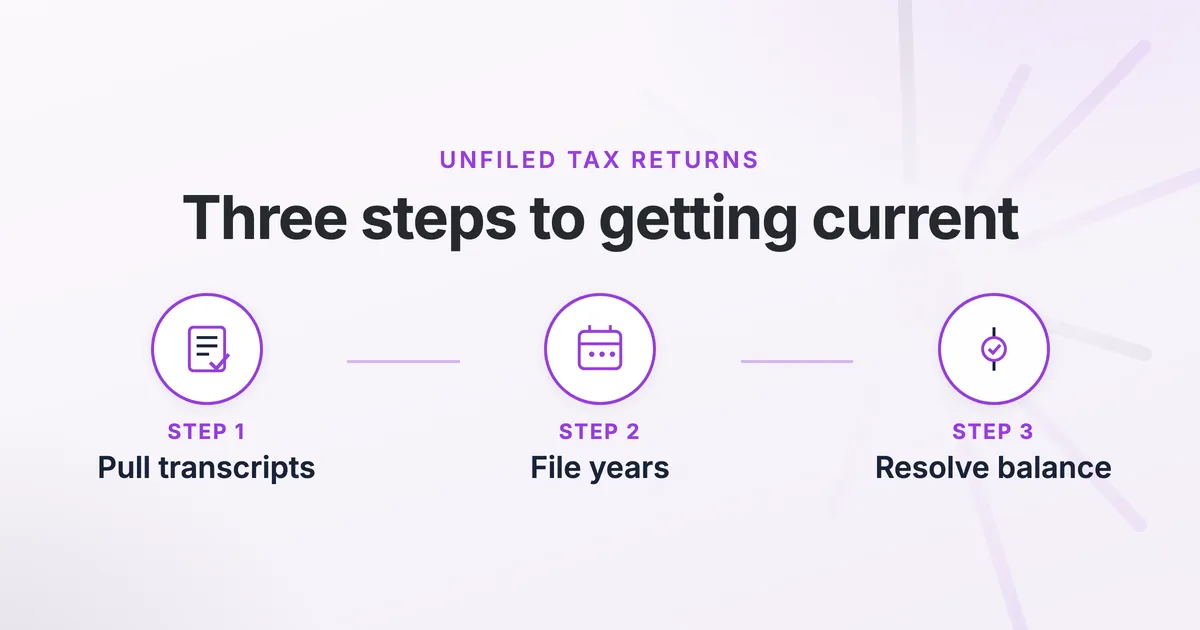
The sequence matters, and doing it in the wrong order wastes months.
Start With the Transcripts
Wage and income transcripts show every information return the IRS received for each year. That is the raw material for reconstructing a return when your own records are gone, and it is also how we find out whether a substitute return has already been filed against you. We pull these as the first step of every unfiled case.
File the Years the IRS Wants
Compliance generally means filing the last several years rather than every year back to the beginning, and the exact number depends on your circumstances and what the IRS is asking for. This surprises people who assume they need a decade of returns before anyone will talk to them. Our page on resolving multi year back taxes covers how those years get sequenced.
Resolve What Is Left
Filing produces an accurate number. That number is what gets resolved, through a payment plan, an offer in compromise, or hardship status where the income genuinely is not there. Our page on currently not collectible status covers the hardship route for taxpayers whose income barely covers necessities.
Getting Current in Illinois and Nevada
Illinois taxpayers have a second front. The Illinois Department of Revenue runs its own filing and collection track, and getting federally current does not clear the state side. Nevada has no state income tax, so Las Vegas clients have one agency to satisfy, though Nevada business taxes can still be in play for company owners.
Either way, this is work you never have to do in a room with the IRS. We file the power of attorney, pull the transcripts, prepare the returns, and take the calls. Our clients never meet with the IRS.
If you have been behind for a year or for a decade, the first conversation costs nothing and it is not a lecture. Tell us how many years are open and we will map exactly what getting current looks like from here.
FAQ
Can you skip a year filing taxes?
Nothing physically stops you, but the year never closes. There is no statute of limitations on assessment for an unfiled year, so the IRS can assess it at any point in the future, and penalties accrue from the original due date if tax was owed.
What is the 3 year rule for the IRS?
To claim a refund you generally have three years from the original due date of the return to file it. After that the refund is forfeited to the Treasury. A separate three year clock governs how long the IRS has to assess additional tax on a return that was filed.
Will the IRS know if I don’t file taxes?
Yes, in most cases. Employers, banks, brokerages, and clients file information returns tied to your Social Security number, and the IRS matches those documents against filed returns. A missing return with information documents behind it gets flagged, though the lag can be a year or more.
What happens if I don’t do my tax return for 2 years?
Expect delinquency notices requesting the missing returns, penalties and interest accruing on both years, and the account flagged for the substitute return process. Two years is still comparatively easy to fix, because records are recent and no substitute return has usually been filed yet.

Written by
William Sharpe, E.A., C.T.R.S.
Founder & Certified Tax Resolution Specialist
William has been in the tax business since he was 8 years old, starting in the mail room of the family enterprise. He began filing tax returns in 1999 and spent decades shadowing his grandfather, founder Bill Sharpe. In 2005 he teamed with Bill & Deborah Sharpe to open Total Income Tax — today the busiest tax office in Peoria — and in 2016 he founded Total IRS Relief to help taxpayers resolve their IRS and Illinois tax struggles.
Meet the teamNeed help with your case?
Talk to an Enrolled Agent. Free 15-minute consultation, no obligation.