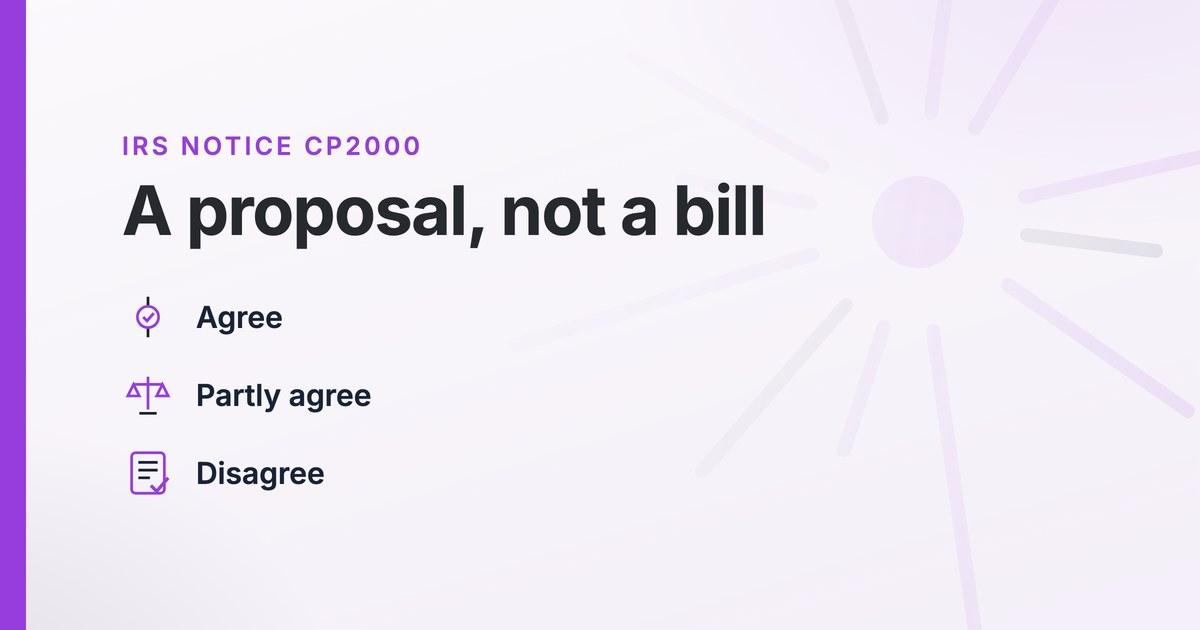
The letter arrives with numbers in a table and a total at the bottom, and the total is the only thing most people read. It looks like a bill. It is not a bill, and the difference is not a technicality. It changes what you are allowed to do next and how much time you have to do it.
We work these every month from Peoria and Las Vegas, and the most useful thing to know before you read another line of it is that a CP2000 is a proposal you are being invited to argue with.
What a CP2000 Notice Is
A CP2000 is the IRS telling you that income or payment information it received from a third party, such as an employer or a financial institution, does not match what you reported. The notice sets out proposed changes and the information behind them. The IRS states directly that the notice is not a bill, that the difference may increase your tax, decrease it, or change nothing at all, and that your response may be required.
A CP2000 Is Not an Audit
What the IRS Is Actually Doing
This is a document matching exercise, not an examination. A computer compared the W-2s, 1099s, 1098s and broker statements filed under your Social Security number against the figures on your return, found a gap, and generated a proposal. Nobody has opened your books. Nobody has questioned your deductions except where a specific document contradicts one.
That distinction matters practically. The proposed tax on a CP2000 is frequently wrong in the taxpayer’s favor once the full picture is supplied, because the IRS knows what came in and does not know what it cost you. A 1099 for a stock sale reports the proceeds, not what you paid for the shares. A 1099-NEC reports gross receipts, not the expenses against them.
When It Can Turn Into One
If an agreement is not reached, or you do not respond and do not get an extension of time to respond, the IRS sends a Statutory Notice of Deficiency by certified mail. That letter carries 90 days to petition the United States Tax Court, and that window cannot be extended beyond the original 90 days, as Publication 5181 sets out. You can keep working with the IRS during those 90 days. You cannot buy more of them.
So a CP2000 does not become an audit. It becomes an assessment, which is a harder thing to unwind.
The Letters That Come Before and Beside It
A CP2000 rarely arrives alone in the abstract. The IRS runs a small family of matching letters and knowing which one you have tells you how far the process has gone.
A CP2501, or Letter 2531, is the earlier one. It says your return does not match what a payer reported, and it does not yet compute additional tax. If you agree, you sign and return the response form and the IRS then works out the tax and sends you a CP2000. If you disagree, you send your documentation at that stage and the CP2000 may never be issued at all.
A Letter 2030 is the CP2000’s twin, sent in circumstances where the IRS uses a letter rather than a notice number, and it is handled the same way.
The CP2000 itself comes in a series, CP2000 through CP2000E, and the suffix reflects the circumstances rather than a different process.
Getting a CP2501 and treating it as a bill is the most expensive misreading in this family, because it is the one point where a document can end the matter before any tax is proposed.
Is the Notice Legitimate
Scam letters imitating IRS notices circulate every autumn, and CP2000 is a favorite because it carries a dollar figure and a deadline.
A real CP2000 gives you a payment address at an IRS service center, never an individual, a company, or a payment app. It gives you a response form or instructions to follow, not a phone number demanding immediate payment. It does not threaten arrest. And it will match an entry in your IRS online account, which is the fastest way to settle the question without calling anyone.
If the numbers on the notice describe income you never earned at all, that is a different problem from an underreporting question, and the IRS’s own instruction is to send your reply together with a completed Form 14039, the identity theft affidavit.
How to Respond
The notice tells you the date to reply by. Work backwards from it, because the evidence takes longer to gather than the letter takes to write.
If You Agree
Sign and return the response form by the due date. If you filed jointly, the IRS requires both signatures. The IRS then computes the tax and bills you, and you do not need to file an amended return unless you have other income, credits or expenses to report that were not on the notice.
If You Partly Agree
This is the most common real answer and the one the form handles least intuitively. You mark disagreement, then explain item by item which proposed changes you accept and which you do not, with documentation for each disputed line. A partial agreement handled well often removes most of the proposed tax.
If You Disagree, and What Evidence Looks Like
Evidence means the document that contradicts the IRS’s document. A corrected 1099 from the payer. A broker statement showing cost basis. A closing statement. A canceled check. A letter from the business that reported the figure, explaining why it was wrong.
What is not evidence is an explanation on its own. The IRS is reconciling paper against paper, and a paragraph describing what really happened, with nothing attached, is the version of a response that comes back unchanged.
If a payer reported something incorrectly, ask them for a corrected document or a written statement explaining the error, then send us a copy with your response.
This is the point at which most people find out the notice is only half the picture. The wage and income transcript shows everything filed under your number, including documents you never received, and reading it against the notice before you reply is what our IRS case investigation does first.
The Response Form and the Deadline
The IRS now treats its document upload tool as the fastest route, using the access code printed on the notice, and accepts a fax to the number on the top left of the letter or mail to the address in the same corner. Choose one. Sending the same reply three ways creates three records of it.
If you need more time, ask for it in writing before the date passes rather than after.
How Long the IRS Takes to Answer You Back
Longer than the deadline it gave you, and that asymmetry is what unsettles people. The IRS reviews the reply and contacts you if more information is needed, and a response that has been sent is not a response that has been worked. Interest accrues on any balance that is ultimately due while all of this happens.
Do not treat silence as agreement in either direction, and do not send a second copy of your reply into the gap.
If You Miss the Deadline
What Comes Next in the Notice Sequence
The IRS may send another notice and a bill, and from there the account joins the ordinary collection sequence. Balance due notices first, then the final notice that carries appeal rights, then enforcement. Our IRS notice guide sets out the codes and the deadline printed on each one, and the notice lookup decodes a specific letter in seconds.
Missing the CP2000 deadline does not end the argument, but it moves it. Once the tax is assessed you are asking to have something reversed rather than asking for it not to happen, and that is a slower and narrower conversation.
Why We See These So Often in Central Illinois
The households that get a CP2000 are rarely hiding anything. They are the ones with income arriving from more than one place. Farm income alongside a W-2. A retirement distribution nobody withheld against. Gig and delivery work paid across three platforms, each issuing its own document. A brokerage account that reported a sale where the gain was small and the proceeds looked large.
Every one of those produces a paper trail the IRS receives whether or not the taxpayer remembers it, and every one has a straightforward answer once the offsetting document is in hand. Our post on which IRS notices can be ignored and which cannot puts the CP2000 in the wider sequence.
Answer It Before the Date on the Letter
Before answering a CP2000, we pull your wage and income transcript and read it against the notice. That single step tells us whether the IRS’s figures are complete, whether the same problem exists in an adjacent year that has not been noticed yet, and whether the proposal is worth agreeing to. Our IRS case investigation page explains the pull, and our services page covers what happens if a balance survives the response.
If there is a CP2000 on your table, bring it to us before the deadline rather than after. You never meet with the IRS. We do. Call 877-924-1040 or reach us through our contact page.
FAQ
What happens if the IRS sends a CP2000 notice?
The IRS is proposing changes because third party information does not match your return. It is not a bill. You reply by the date on the notice saying whether you agree, partly agree, or disagree, with documentation for anything you dispute.
Does a CP2000 trigger an audit?
No. It is automated document matching rather than an examination. What it can lead to, if you do not reach agreement or do not reply, is a Statutory Notice of Deficiency, which carries 90 days to petition the Tax Court and cannot be extended.
How do I respond to a CP2000 letter?
Complete and sign the response form if one is included, state your position, and attach supporting documents. Send it one way only, either through the IRS document upload tool with the access code on the notice, by fax to the number on the top left, or by mail to the address in the same corner.
What documentation is needed for CP2000?
Whatever contradicts the IRS’s document. A corrected 1099, a broker statement showing cost basis, a closing statement, a canceled check, or a written explanation from the payer that reported the figure. An explanation with nothing attached is not documentation.

Written by
William Sharpe, E.A., C.T.R.S.
Founder & Certified Tax Resolution Specialist
William has been in the tax business since he was 8 years old, starting in the mail room of the family enterprise. He began filing tax returns in 1999 and spent decades shadowing his grandfather, founder Bill Sharpe. In 2005 he teamed with Bill & Deborah Sharpe to open Total Income Tax — today the busiest tax office in Peoria — and in 2016 he founded Total IRS Relief to help taxpayers resolve their IRS and Illinois tax struggles.
Meet the teamNeed help with your case?
Talk to an Enrolled Agent. Free 15-minute consultation, no obligation.