Open an IRS transcript for the first time and it reads like a bank statement written by somebody who did not want you to understand it. Three digit codes down the left. Two different dates on the same line. Numbers that are negative when you expected them to be positive.
None of it is arbitrary. Every line is an instruction the IRS gave its own system, and once you know what the columns are doing the document becomes the most honest picture of your tax account that exists anywhere.
How to Read Your IRS Transcript
Read it in four columns. The code is a three digit transaction code identifying what happened. The explanation is the IRS’s plain English label for that code. The cycle date is when the IRS processed the transaction, and the date beside it is the effective date of the transaction itself. The amount is what posted, and a negative amount is money in your favor.
The Four Transcript Types and Which One You Actually Want
Most people pull the wrong one first. The IRS transcript types page describes all four, and they answer different questions.
Tax Return Transcript
Most line items from your original return as you filed it, with the forms and schedules. It does not show anything that changed afterwards. Lenders usually want this one. It is available for the current and three prior tax years, and it is the least useful transcript if you have a tax problem, because a tax problem is by definition something that happened after filing.
Tax Account Transcript
Filing status, taxable income, payment types, and every change made after you filed. This is the one that carries the transaction codes, and it is where a resolution case actually starts. It goes back further too, generally the current and nine prior tax years through an IRS online account.
Record of Account
The return transcript and the account transcript combined into one document, for the current and three prior years. When you want the return as filed and the history of what happened to it side by side, this is the one to ask for.
Wage and Income
Everything third parties reported under your Social Security number, meaning W-2s, 1098s, 1099s and 5498s. Current and nine prior years. Two things to know. Information for the current processing year generally appears in the first week of February, and the transcript is limited to roughly 85 income documents, above which it will not generate at all and you have to file Form 4506-T instead.
This is the transcript that reconstructs years you cannot file because the paperwork is gone. It is also the transcript that answers the question people are most afraid to ask, which is what the IRS already knows. Everything on it was reported to the agency by somebody else, so a wage and income pull is the difference between guessing at an unfiled year and preparing it from the same documents the IRS is holding.
The Refund Codes People Are Looking For
846
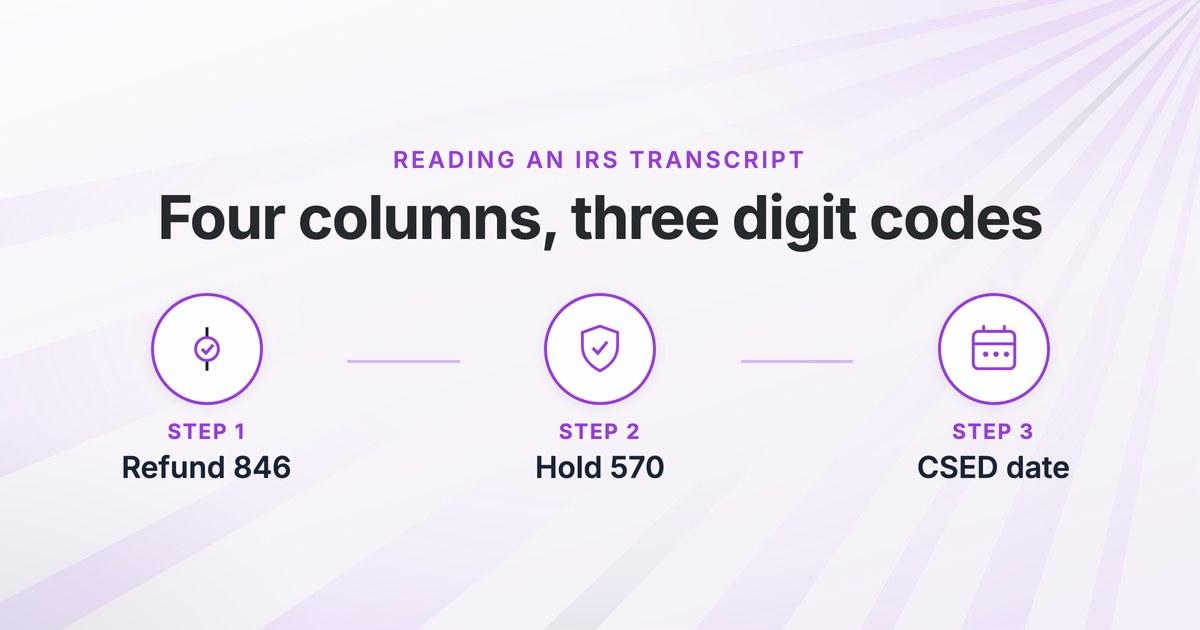
Transaction code 846 is the refund. The Taxpayer Advocate Service describes it as representing the issuance of a refund where credits and withholding exceed the tax due and nothing on the return is in question, and its transcript decoding guide lists it alongside the rest of the common set. The date beside an 846 is the date the refund was issued, not the date it reaches an account.
570 and 971
These two turn up together often enough that people assume they mean one thing. They do not.
A 570 is described as additional account action pending. It is a hold. Something on the account is unresolved and the system will not release an overpayment until it is. TAS explains that a 570 freeze is released by a subsequent adjustment, including a zero dollar adjustment entered specifically to lift it when no tax change is warranted.
A 971 is a notice issued. It records that the IRS generated a letter, and the explanation text beside it names which one. A 570 followed by a 971 is usually the account telling you a hold went on and a letter went out about it, and the letter is the thing worth reading.
Reading the Cycle Date
The cycle date and the transaction date are not the same field. TAS puts it plainly. A transaction date is the effective date of a transaction on the account, and the cycle date is the date the IRS processed it. A cycle date such as 20260605 is a year, a week number, and a day within the processing week.
That gap explains one of the most common questions we get, which is why a bill is dated after a payment that is visibly sitting on the account. The system computes penalties and interest against transaction dates, so when a bill looks wrong the cycle date on the payment is usually the thing to check first.
The Codes That Matter When You Owe
The refund codes get the attention. The collection codes decide the case.
The Assessment Codes
TC 150 is the return as filed or as the IRS corrected it on processing, with the tax shown. TC 300 is an additional assessment made by examination or collection. TC 291 is an abatement of a prior assessment. TC 276 is the failure to pay penalty and TC 196 is interest assessed.
Read together, those lines tell you not just what you owe but where the balance came from, which is the difference between a balance you can dispute and one you cannot.
The Collection Status Codes
TC 420 is an examination indicator, meaning a return is under consideration for audit though it may never be audited. TC 480 records an offer in compromise pending. TC 494 is a notice of deficiency. TC 520 is litigation instituted. TC 530 indicates the account has been placed in currently not collectible status. TC 582 is a lien indicator.
A single one of those changes what should happen next. A 582 on an account means a lien is filed and a refinance is about to become complicated. A 530 means the IRS has already accepted that the taxpayer cannot pay, which is worth knowing before anyone proposes a payment plan.
What the CSED Date Tells You
The account transcript carries the dates behind the IRS’s collection statute, which is the deadline the agency works to. For anyone with an older balance it is the most valuable figure on the page, and it is also the one most often miscalculated, because events during the account’s life can suspend it. Our statute of limitations review covers how we verify those dates rather than estimating them.
How to Get Your Transcript
Online
An IRS individual online account will display, print or download all four types. Registration requires an identity verification step, which is where most people stall.
By Mail or By Phone
You can order a return transcript or an account transcript through Get Transcript by Mail or by calling the automated line at 800-908-9946, and the IRS asks you to allow 5 to 10 calendar days for delivery. Any of the four types can be requested by filing Form 4506-T. The transcripts themselves are free.
When We Pull It for You
We pull IRS account, wage and income, and CAF transcripts under FOIA, quietly, across a ten year range, and map every assessment, payment, penalty and statute date into a written case memo in plain English. That is the first step of every case we take, and it is described in full on our IRS case investigation page.
The reason we start there is not thoroughness for its own sake. It is that a resolution strategy chosen without the transcripts is a guess, and the transcript routinely contains something the taxpayer did not know was there.
Reading the Whole Account, Not One Line
If you are watching for a refund, the codes above are the whole story and the tool will catch up with them. If you are reading a transcript because something is wrong, the codes are a starting point rather than an answer, and the useful question is what the sequence of them means together.
Our glossary covers the terms these documents assume you know, and our IRS notice guide matches a notice code to the transaction code that generated it.
If you want somebody to read the whole account rather than one line of it, talk to an Enrolled Agent in Peoria or Las Vegas, and our team page puts names and credentials to the people on the other end of that call. You never meet with the IRS. We do. Call 877-924-1040 or reach us through our contact page.
FAQ
What does the minus mean on a tax transcript?
A negative amount is a credit to you rather than a charge. TAS puts tax credits, withholding credits, interest the IRS owes you, and adjustments that reduce your tax in that category, so a minus sign is money in your favor.
Does your tax transcript show a refund date?
Yes, on transaction code 846. The date beside an 846 is the date the refund was issued by the IRS, which is not the same as the date it lands in your account.
What does cycle 20260605 mean on tax transcript?
It is a processing cycle rather than a calendar date, made up of the year, the week of the processing year, and the day within that week. It records when the IRS processed the transaction, as distinct from the transaction date, which is when the transaction took effect.
What do the codes mean on an IRS transcript?
They are transaction codes, three digit instructions the IRS gives its own system, each with a plain English label beside it. TC 150 is the return as processed, 846 is a refund issued, 570 is a hold, 971 is a notice issued, 530 is currently not collectible status, and 582 indicates a lien.

Written by
William Sharpe, E.A., C.T.R.S.
Founder & Certified Tax Resolution Specialist
William has been in the tax business since he was 8 years old, starting in the mail room of the family enterprise. He began filing tax returns in 1999 and spent decades shadowing his grandfather, founder Bill Sharpe. In 2005 he teamed with Bill & Deborah Sharpe to open Total Income Tax — today the busiest tax office in Peoria — and in 2016 he founded Total IRS Relief to help taxpayers resolve their IRS and Illinois tax struggles.
Meet the teamNeed help with your case?
Talk to an Enrolled Agent. Free 15-minute consultation, no obligation.