This is the question we get more than any other, usually phrased as some version of whether waiting it out is a strategy. It is a fair question with a real answer, and the answer has more moving parts than the internet suggests. Here is what the collection statute actually does, how to find your own date, and why the calendar the IRS is working from is almost never the one taxpayers calculate for themselves.
Does Tax Debt Expire
Yes. Federal tax debt expires. Under Internal Revenue Code section 6502 the IRS generally has 10 years from the date a tax is assessed to collect it, and when that date passes the balance is written off and the lien is released. The date is called the Collection Statute Expiration Date, or CSED. The catch is that the 10 years does not run continuously. Several common events pause it, and each pause pushes the date further out.
How Long Does IRS Tax Debt Last
Ten years per assessment, which is not the same as 10 years per tax year, and the difference matters. The clock starts on the assessment date, meaning the day the IRS formally recorded the liability, not the day the tax year ended and not the day you filed.
That distinction produces results people find counterintuitive. A return filed three years late has an assessment date three years later than a timely one, so the debt lives three years longer. A year with an original balance plus a later audit adjustment has two assessments with two separate expiration dates, and the second one can survive the first by years. A single tax year can therefore be part expired and part collectible at the same time, which is exactly what we find when we open transcripts on an old case.
Does the IRS Forgive Debt After 10 Years
Forgiveness and expiration are two different things, and the distinction is worth holding onto. The IRS does not forgive the debt in the sense of deciding you no longer owe it. The statutory period to collect simply runs out, and the IRS loses the legal authority to enforce it. The write off is administrative, not a judgment about your circumstances.
Practically the result looks similar. The balance comes off the account, the federal tax lien self releases, and collection stops. There are two footnotes worth knowing. The IRS can sue to reduce a liability to judgment before the CSED expires, and a judgment carries its own much longer life. And an expired federal balance does not touch a state balance, which runs on its own state timetable.
If you are hoping for a resolution rather than an expiration, that is a different conversation with better odds. Our page on settling tax debt for less than you owe covers what actual forgiveness through an offer in compromise requires.
How Do I Know If My Tax Debt Has Expired
You read it off your IRS account transcript, one tax year at a time. The transcript shows the assessment date for each liability and the transaction codes for events that suspended the clock. From there the CSED is a calculation, not a lookup, because the transcript does not print a single tidy expiration date for you.
Three practical notes from doing this work. First, order account transcripts for every year with a balance, not just the oldest one, because the years expire independently. Second, the IRS can tell you a CSED over the phone, and the figure it gives is the figure it will act on, so it is worth getting. Third, an IRS calculated CSED can be wrong. Suspensions get recorded incorrectly, and a date that reflects a suspension that never happened is challengeable.
Nearly every taxpayer who calculates this without transcripts arrives at a date that is too early, usually by years, because they counted from the tax year instead of the assessment and skipped the pauses entirely.
How Many Years Can IRS Go Back on Taxes
Two different lookbacks get mixed together here. Assessment is one, and collection is the other.
For assessment, the IRS generally has three years from the date a return was filed to assess additional tax. That extends to six years when income is substantially understated, and it never expires at all for a fraudulent return or a return that was never filed. This is the piece that catches people. An unfiled year has no assessment deadline, so the IRS can assess it decades later and start a fresh 10 year collection clock from that date.
That is also why the substitute return process quietly resets the calendar. When the IRS prepares a return for a year you skipped, the assessment that follows starts the collection clock as of that day. Our pages on what happens when the IRS files a substitute for return and how bad years of unfiled returns really get cover how those assessments arise.
For collection, the answer is the 10 year CSED already described, running from each assessment and extended by every suspension on the record.
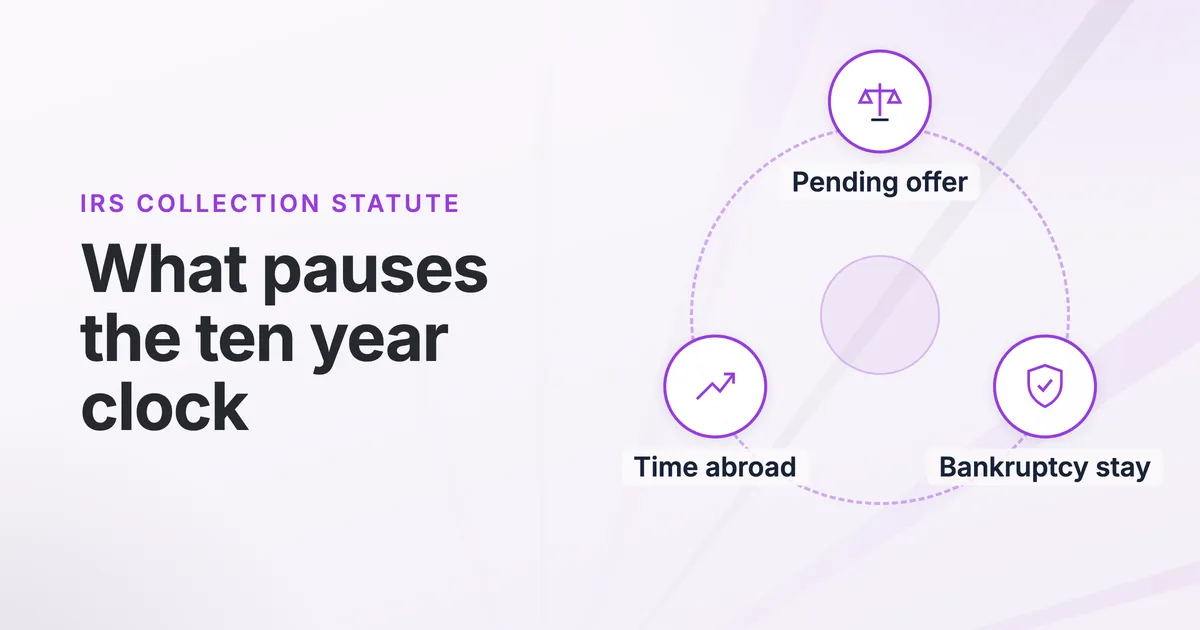
What Pauses the 10 Year Clock
Suspension is the reason so few debts expire on the schedule taxpayers expect. The common events look like this.
A pending offer in compromise suspends collection while it is under review, plus an additional period after a rejection while appeal rights run. An offer that takes a year to be rejected costs you more than a year of clock.
A bankruptcy filing suspends the clock while the automatic stay is in place and for an additional six months afterward.
A requested Collection Due Process hearing suspends collection while the hearing and any appeal are pending. So does a pending request for an installment agreement, and a rejection carries an additional suspension period while appeal rights run.
Living outside the United States continuously for six months or longer suspends the clock for the entire absence, and the statute does not expire until a period after your return.
Certain requests for taxpayer assistance and specific relief applications also suspend collection while they are open.
None of that means those steps are mistakes. An offer in compromise that settles the debt for a fraction of the balance is worth the suspension it costs. The point is that every protective action has a calendar cost, and the two need to be weighed together rather than one at a time.
Why Waiting Out the Collection Statute Usually Backfires
The strategy of going quiet until the CSED passes fails for a specific reason. The IRS knows the date too, and it works accounts harder as expiration approaches. Late statute accounts get assigned rather than sitting in the automated queue, which means a revenue officer, a levy, or a lien filing right when a taxpayer thought the finish line was close. Our page on what happens when a revenue officer is assigned describes how that stage tends to go.
There is also the cost of the waiting itself. Interest and penalties compound the entire time. A federal tax lien sits on your credit and your property throughout. Refunds are seized each year. And every year of silence increases the chance the IRS takes an action that suspends the very clock you were waiting on.
The supervised alternative is hardship status. Currently not collectible status stops active collection because you genuinely cannot pay, and the collection clock keeps running while you are in it. That is the version of waiting it out that actually works, because it is on the record instead of in hiding. Our pages on currently not collectible status in Illinois and Nevada and CNC status for Peoria taxpayers walk through who qualifies and what it takes to get placed there.
Find Out Where Your Collection Clock Actually Stands
Everything above turns on one document you can have in a few days. We pull your IRS account transcripts, identify the assessment date for every year with a balance, map the suspensions the IRS has recorded, and give you a real expiration date for each year rather than a guess.
Sometimes that conversation ends with good news, because the oldest year is closer to expiring than anyone thought. Sometimes it ends with a plan, because the newest assessment has most of a decade left and hiding from it for that long is not a life. Either way you will know. Ask us to pull your collection clock and we will read the transcripts with you at no cost.
FAQ
Does the IRS forgive debt after 10 years?
Not exactly. The IRS loses the legal authority to collect once the collection statute expires, generally 10 years from assessment, and writes the balance off. That is expiration rather than forgiveness, and the clock is suspended by events such as a pending offer in compromise, a bankruptcy, or extended time outside the country.
How do I know if my tax debt has expired?
Order your IRS account transcript for each year with a balance, find the assessment date, and account for any recorded suspensions. The IRS will also give you its calculated expiration date on request, and that date can be challenged if the recorded suspensions are wrong.
How long does IRS tax debt last?
Generally 10 years from the date of assessment for each liability, not from the tax year or the filing date. A single tax year can carry more than one assessment with more than one expiration date, and suspensions extend every one of them.
How many years can IRS go back on taxes?
For assessing additional tax, generally three years from filing, six years when income is substantially understated, and unlimited for a fraudulent or unfiled return. For collecting an assessed balance, the 10 year collection statute applies, extended by any suspensions.

Written by
William Sharpe, E.A., C.T.R.S.
Founder & Certified Tax Resolution Specialist
William has been in the tax business since he was 8 years old, starting in the mail room of the family enterprise. He began filing tax returns in 1999 and spent decades shadowing his grandfather, founder Bill Sharpe. In 2005 he teamed with Bill & Deborah Sharpe to open Total Income Tax — today the busiest tax office in Peoria — and in 2016 he founded Total IRS Relief to help taxpayers resolve their IRS and Illinois tax struggles.
Meet the teamNeed help with your case?
Talk to an Enrolled Agent. Free 15-minute consultation, no obligation.