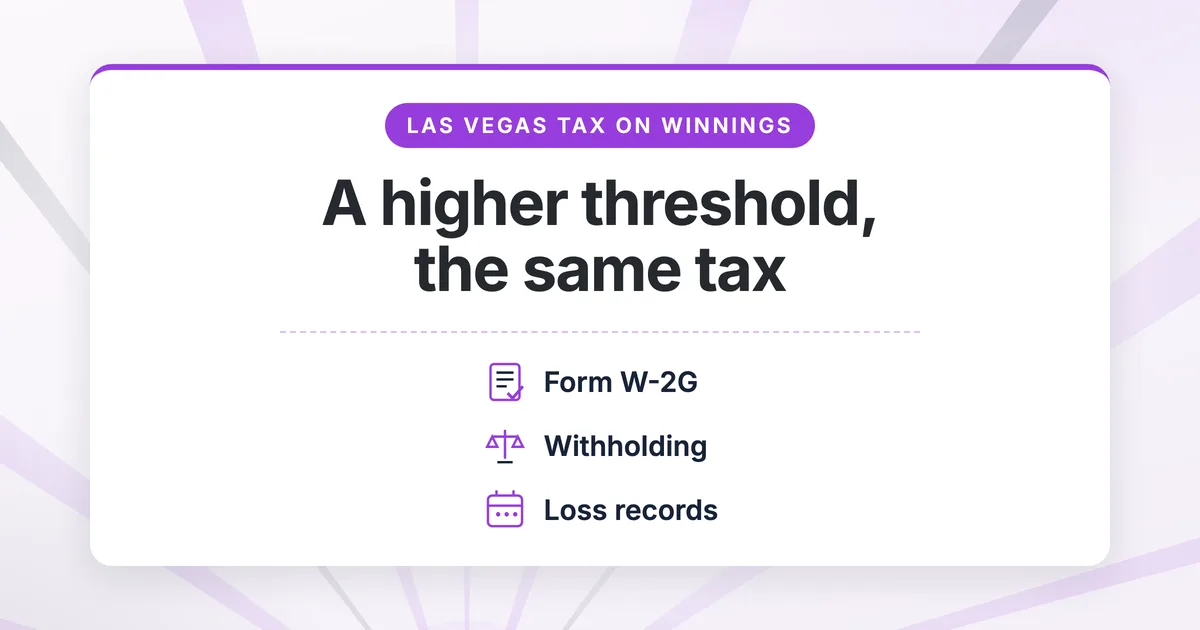
Nevada has no state income tax, so the tax on Las Vegas winnings is federal, and every dollar counts as income on your return. The casino issues a Form W-2G for larger payouts and withholds on some of them. Whatever that withholding doesn’t cover is due when you file, along with any tax on wins that never got a form.
If a win has already turned into a balance you can’t pay, call our Las Vegas office at (702) 342-2170 or ask for a free case review. We work with Southern Nevada residents, not tourists passing through.
What Happens if I Win $100,000 at the Casino?
On a six-figure win, the casino verifies your identity, issues a Form W-2G and, depending on the game, may withhold federal tax before paying you. Slot jackpots aren’t subject to regular withholding, so one can arrive with nothing held back. Either way, the full win goes on your federal return and is taxed at your own rates.
The withholding rules depend on the game. Under the IRS instructions for Form W-2G, regular gambling withholding is 24% on certain wagers where the winnings minus the wager are more than $5,000, such as lotteries, sweepstakes and sports wagering. Bingo, keno and slot winnings aren’t subject to it, though backup withholding at the same rate applies if you don’t give the casino a taxpayer ID. A winner at a reporting threshold on slots also has to show two forms of identification.
Why Nevada’s Lack of an Income Tax Doesn’t Change the IRS Side
No state income tax means no Nevada return, not no tax. IRS Topic 419 says gambling winnings are fully taxable, including cash and the fair market value of prizes like cars and trips, and that you must report all of them on your return, including winnings that never appeared on a W-2G.
That second part catches people. A string of smaller wins below the form threshold is still income, and so is a prize you took instead of cash.
Prizes follow their own rules. The W-2G instructions say a non-cash payout, such as a car won in a sweepstakes, counts at its fair market value, and when that value minus the wager exceeds $5,000 on the games that carry regular withholding, the 24% is figured on it too. With a car there’s no cash to hold back, so the winner pays that withholding to the payer. Budget for it before you accept the keys.
How Much of a Big Payout Is Actually Tax
Withholding Versus What You Owe
Withholding is a payment toward your tax, not the tax itself. A large win is added to the rest of your income for the year, and depending on where that lands, your federal rate on the top slice can be higher than what the casino held back. Topic 419 also notes that a win can mean you owe estimated tax during the year, rather than waiting for April. On a slot jackpot with no withholding at all, the whole bill arrives with the return.
Losses and the Records That Support Them
Losses can help, but only in a narrow way. The IRS says you can deduct gambling losses only if you itemize, only up to the amount of winnings you report, and only if you’ve kept an accurate diary or similar record backed by receipts, tickets or statements. If you take the standard deduction, losses don’t reduce the tax on your winnings at all.
What Changes for 2026 Winnings
The reporting threshold now moves with inflation. The W-2G instructions, revised in January 2026, say the minimum threshold for reporting on certain information returns, including Form W-2G, will be adjusted yearly for inflation after 2025, and they put the 2026 minimum threshold at $2,000.
A higher threshold means fewer forms, not less tax. Wins under it are still income, and the IRS expects them on the return.
When Winnings Turn Into an IRS Notice
Casinos send W-2G information to the IRS. When a return leaves it off, the IRS’s matching can catch the difference and propose more tax, with interest and sometimes a penalty. Our guide to the CP2000 notice explains that letter and how to answer it.
Some winners don’t file at all in the year of a big payout, which makes things worse. Here’s what happens if you don’t file taxes and how the IRS responds. Penalties that follow a first mistake can sometimes be reduced, and we check whether penalty abatement fits your situation before anything is paid.
How We Help Las Vegas Winners Who Now Owe
A tax bill from winnings is still an IRS balance, and it’s resolved the same way as any other. Many of our clients set up a payment plan for a tax bill from winnings so the balance doesn’t sit and grow. We start by pulling the IRS’s own record of your W-2Gs and other income, so we know the balance is right before we negotiate it. We’re enrolled agents licensed by the IRS, and we deal with the IRS so you don’t have to.
For casino employees, tip income raises its own questions, which we cover separately in our post on tip compliance for casino workers. If you live in Las Vegas, Henderson, North Las Vegas or Summerlin and a win has left you owing the IRS, reach out for tax help in Las Vegas at our office on South 6th Street.
FAQ
How much is $100,000 after taxes in Las Vegas?
There’s no Nevada income tax, so the only tax is federal. The win is added to your other income and taxed at your federal rates, so the amount you keep depends on the rest of your income for the year, not on the win alone. Any casino withholding counts toward that bill.
What happens if I win $100,000 at the casino?
The casino checks your ID, issues a Form W-2G and may withhold federal tax depending on the game. Slot jackpots aren’t subject to regular withholding. You report the full win on your federal return, and any tax the withholding didn’t cover is due when you file.
How much tax do I pay if I win $50,000?
It depends on your total income for the year. The win is taxed as ordinary income at your federal rates, and there’s no Nevada tax on it. Casino withholding on certain games is a prepayment, and the final figure comes from your return.

Written by
William Sharpe, E.A., C.T.R.S.
Founder & Certified Tax Resolution Specialist
William has been in the tax business since he was 8 years old, starting in the mail room of the family enterprise. He began filing tax returns in 1999 and spent decades shadowing his grandfather, founder Bill Sharpe. In 2005 he teamed with Bill & Deborah Sharpe to open Total Income Tax — today the busiest tax office in Peoria — and in 2016 he founded Total IRS Relief to help taxpayers resolve their IRS and Illinois tax struggles.
Meet the teamNeed help with your case?
Talk to an Enrolled Agent. Free 15-minute consultation, no obligation.