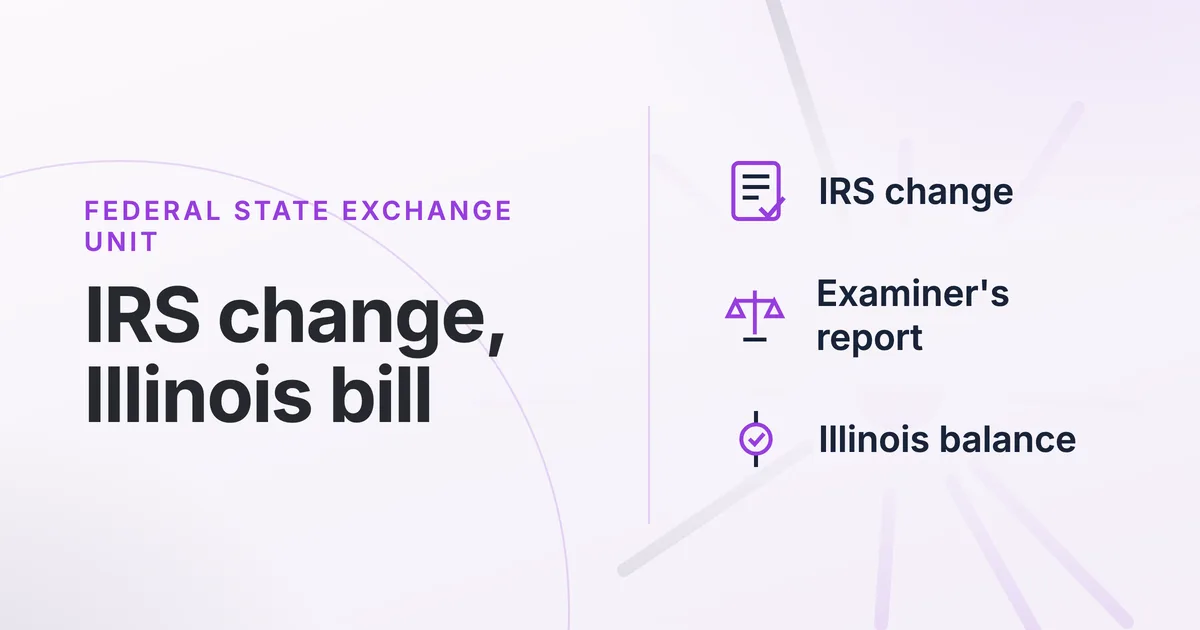
The Federal State Exchange Unit is an Illinois Department of Revenue team that uses the tax information the IRS shares with Illinois to examine individual income tax returns. When your federal figures change, this unit can follow with a Notice of Proposed Tax Due and an Examiner’s Report showing what Illinois thinks you owe.
The letter can arrive well after the IRS side feels settled. If you’re holding one, call our Peoria office at (309) 681-8900 or send us the notice through our contact page, and we’ll look at the federal and Illinois sides together.
What Is the Federal State Exchange Unit in Illinois?
It’s part of the Illinois Income Tax Division. According to the Department’s FSEU questions page, the unit uses federal tax information exchanged between the IRS and the Department to examine individual returns, and section 6103(d) of the Internal Revenue Code authorizes that exchange.
Its first letter is the Notice of Proposed Tax Due, numbered ITR-61-G or ITR-61-S. The Department sends it when the information available to it points to tax that may be due, and it comes with Form EDA-131, the Examiner’s Report, which lists the proposed changes to your Illinois return. The same unit also sends a notice when the information points the other way, toward an unclaimed Illinois earned income credit and a possible refund.
Why Illinois Follows the IRS
The Information Exchange Under Federal Law
Federal tax information is confidential, but federal law lets the IRS share it with state tax agencies for their own tax administration. Illinois uses that channel. So when the IRS adjusts your return, the change doesn’t stay federal for long.
The IRS Changes That Usually Trigger It
The Illinois return is built on figures from the federal one. The Department’s page names the federal items it works from, which are adjusted gross income, filing status, exemptions and the earned income tax credit. If the IRS raises your adjusted gross income after matching a 1099 or W-2 you missed, the Illinois return built on the old figure is now wrong too.
It’s a familiar sequence. An underreporting notice arrives, the federal balance gets settled, and the Illinois notice follows later. We explain the federal side of that pattern in why central Illinois households see underreporting notices.
What the Notice of Proposed Tax Due and the Examiner’s Report Say
The notice tells you that Illinois proposes a change and explains when and how to respond. The Examiner’s Report shows the detail line by line. The Department asks you to compare that report with your own federal and state records.
If you agree, you sign the Examiner’s Report and send it back. If you don’t, you follow the directions on the notice and back up your position with your records. The Department takes responses by email, fax or mail at the contacts listed on its FSEU page, and your notice sets out the details for your case.
If you call the unit, have the letter and your federal and state records for that year in front of you, because the Department verifies identity before discussing the account. A tax professional calling for you needs an Illinois power of attorney, Form IL-2848, on file.
Checking the Numbers Against Your Federal Records
The quickest proof is usually the IRS’s own record. The Department says that if you’re correcting federal figures such as adjusted gross income, filing status, exemptions or the earned income credit, it will accept an IRS Account Transcript as support.
That’s where we start. Pulling your IRS account transcript shows what the IRS actually changed, when, and by how much, which is often different from what the Illinois report assumes. If the IRS later reversed or reduced its adjustment, the transcript shows that too, and Illinois can correct its figures from it.
When the Federal Change Itself Is Wrong
Sometimes the Illinois bill is accurate to a federal change that shouldn’t have happened. Then the fix starts with the IRS. If the change came from a CP2000 proposal you never answered, our guide to the IRS notice that usually starts this explains how that notice works. If your own return needs correcting, check how far back you can amend a tax return before you file anything.
Once the federal figure is right, the transcript reflects it, and that becomes the support for your Illinois response.
Paying or Disputing the Illinois Balance
If the Illinois figure is right, it’s a state balance, separate from anything you owe the IRS. Our installment agreement page covers the federal side, and we coordinate state and federal plans so the two monthly payments are affordable together. If the figure is wrong, you answer the notice with your records before the date it gives, and the address for any payment is the one printed on that notice.
How We Handle the IRS and Illinois Sides Together From Peoria
Our Peoria office works with families, farmers, truckers and small business owners across central Illinois, and we handle IRS procedure and Illinois Department of Revenue collections at the same time. We’re enrolled agents, licensed by the IRS, and with an Illinois power of attorney on file, the Department can discuss your account with us.
If you have an IRS notice and an Illinois one on the kitchen table, bring both to our Peoria team for resolving an Illinois tax balance alongside the IRS. We’ll read them against your transcripts and tell you which one to deal with first.
FAQ
What is the Federal State Exchange Unit in Illinois?
It’s a unit of the Illinois Department of Revenue’s Income Tax Division. It uses federal tax information the IRS shares with Illinois to examine individual income tax returns, and it sends the Notice of Proposed Tax Due and Examiner’s Report when it finds a potential balance.
Why would I owe the Department of Revenue?
Most often because your federal return changed. If the IRS raised your adjusted gross income or changed your filing status or earned income credit, the Illinois return built on those figures changes too, and the Department proposes the tax that follows from it.

Written by
William Sharpe, E.A., C.T.R.S.
Founder & Certified Tax Resolution Specialist
William has been in the tax business since he was 8 years old, starting in the mail room of the family enterprise. He began filing tax returns in 1999 and spent decades shadowing his grandfather, founder Bill Sharpe. In 2005 he teamed with Bill & Deborah Sharpe to open Total Income Tax — today the busiest tax office in Peoria — and in 2016 he founded Total IRS Relief to help taxpayers resolve their IRS and Illinois tax struggles.
Meet the teamNeed help with your case?
Talk to an Enrolled Agent. Free 15-minute consultation, no obligation.